Linehaul driving is unforgiving. One bad decision at 65 mph with two loaded trailers behind you can end a career, or worse. These 12 safety tips cover what the research actually shows matters most, from what happens before you ever turn a key to what you do in the minutes after a crash.
1. CDL Jobs Inland Empire
Safety starts before you take a single route. CDL Jobs Inland Empire connects CDL-A drivers with a top-tier FedEx contractor in Southern California's Inland Empire. We run drop-and-hook linehaul freight, which means you're not fumbling with tarps or strapping down flatbeds at 2 a.m. The freight is pre-staged. You hook, inspect, and roll.

What makes this setup genuinely safer for drivers: consistent equipment, governed trucks, weekly direct-deposit pay so you're not chasing checks, and a clear onboarding process that covers safety expectations before your first dispatch. Drivers who know exactly what's expected don't improvise. Improvised safety is where incidents happen.
We reward safe driving with monthly performance bonuses. That's not a pitch. It's a structure that gives you a financial reason to drive the way you already want to drive. New drivers get orientation training completed before their first dispatch, not after.
The one honest caveat: this is Southern California regional linehaul, not OTR. If you want to cross multiple time zones on one run, this isn't that. But if stable weekly income and home time matter to you, the trade-off is worth it.
2. Practice Defensive Driving on Every Mile of Highway
Defensive driving isn't a mindset you switch on in bad weather. It's how you operate every mile. For linehaul, that means a following distance of at least seven seconds under normal conditions and more when traffic backs up or the road is wet.
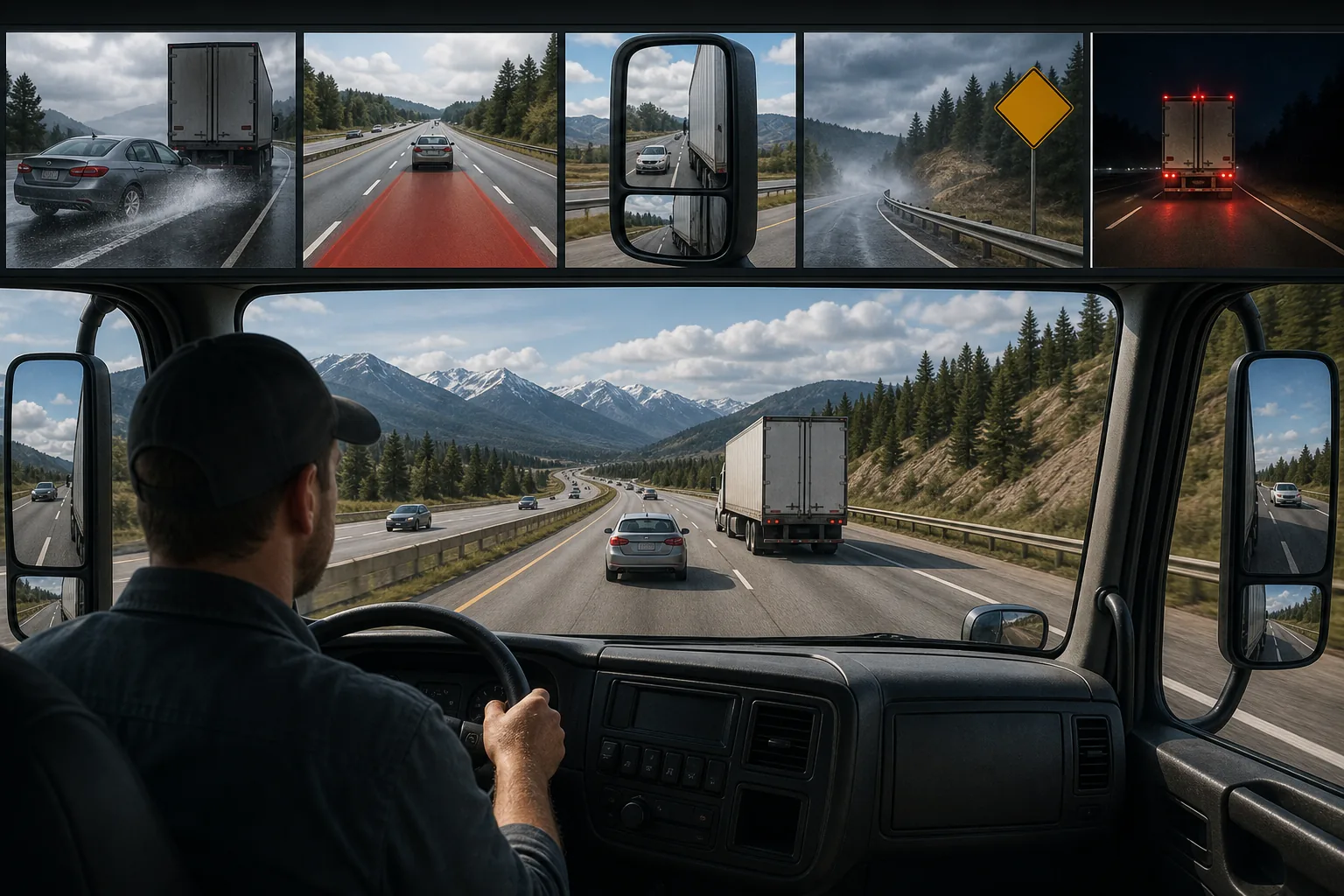
Rear-end collisions account for roughly 22% of truck-related crashes. A loaded combination vehicle doesn't stop like a pickup. By the time you've recognized a hazard and your brakes have fully engaged, you've already traveled a significant distance. Seven seconds gives you a margin. Six doesn't.
Watch the vehicles two and three cars ahead, not just the one directly in front of you. Brake lights three cars forward are your earliest warning. Use them. Also keep a mental escape route in mind at all times, an open shoulder or a gap in the right lane where you can go if the car ahead stops suddenly.
Blind spots are real and they're large. More than a third of fatal crashes involving large trucks involve blind spot situations. Check mirrors every 8 to 10 seconds, signal early before any lane change, and never assume a four-wheeler sees you just because your truck is enormous.
3. Manage Driver Fatigue With Smart Scheduling and Sleep Habits
Fatigue contributes to roughly 13% of truck crashes, and that number is almost certainly undercounted since fatigued drivers don't always admit it in post-crash reports. Hours of Service regulations exist for a reason. Don't treat them as a ceiling to hit. Treat them as the outer boundary of what's safe.

Sleep quality matters as much as sleep quantity. Six fragmented hours in a noisy truck stop isn't the same as six solid hours in a dark, quiet environment. Use blackout curtains in your sleeper. Keep the temperature cool. Turn your phone face-down. These aren't luxury preferences. They directly affect your reaction time on the next run.
If you're fighting microsleeps on a run, pull over. A 20-minute nap in a safe location does more for your safety than any energy drink. Caffeine delays fatigue. It doesn't eliminate it. And when that delay ends, it ends hard.
For drivers at CDL Jobs Inland Empire, our scheduling is designed around consistent start times so your body can actually adapt. Random dispatch windows wreck sleep cycles. Predictability is a safety feature.
4. Use Safety Technology, Dashcams, Telematics, and Driver Scoring
Modern linehaul safety runs on data. Forward-facing dashcams, inward-facing driver cameras, and telematics systems that flag harsh braking or sudden lane changes aren't surveillance tools. They're your best defense when a four-wheeler cuts you off and then claims you hit them.
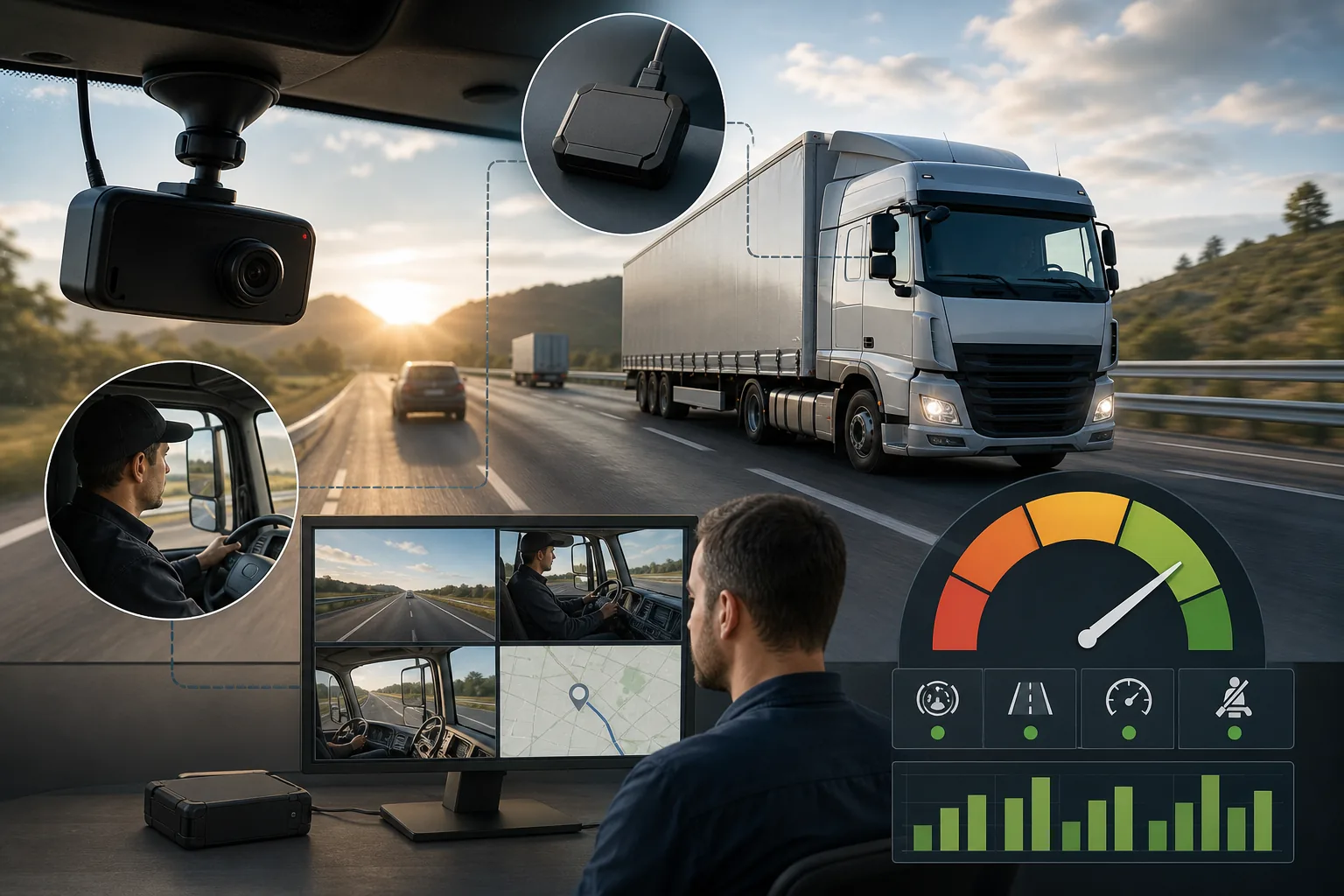
Driver-facing cameras specifically protect you. When footage exists showing you driving correctly, that recording becomes your strongest evidence in any dispute involving another vehicle.
Driver scoring systems, where onboard hardware grades each event like hard braking, speeding, or cell phone use, give you real-time feedback that a quarterly review never could. Some platforms also automate monthly training assignments and driver write-ups, which keeps compliance from falling through the cracks during busy periods.
Telematics data also catches speed violations before they become contract violations. FedEx linehaul contract speed is 65 mph. A truck governed to that limit removes the temptation. If your truck isn't governed, your dispatcher should be watching the data. If nobody's watching, that's a gap worth closing.
5. Know Your Accident and Emergency Response Procedures Cold
Emergency response isn't something you figure out after an accident. By then, you're running on adrenaline and your memory is unreliable. Know the steps now so they're automatic when you need them.

First: stop safely and secure the scene. Turn on your four-ways. Set out triangles or flares at the right distances behind your rig. Check yourself for injury before you move around the vehicle. Then check on other parties involved.
Second: contact your dispatcher immediately. Don't post anything on social media. Don't discuss fault with the other driver. Say as little as possible at the scene beyond what's required for the police report. Your words at an accident scene can follow you into litigation for years.
Third: document everything before conditions change. Take photos of every vehicle involved, the road surface, skid marks, traffic signs, and the surrounding environment. Note the exact time, your speed, weather conditions, and the direction each vehicle was traveling.
Keep a small emergency kit in your cab. Basic first aid supplies, a flashlight, reflective triangles, and a notepad for recording incident details. Every linehaul driver should have this within arm's reach, not buried under gear in the back.
6. Preserve Evidence Immediately After Any Incident, "Freeze the Scene"
Evidence disappears fast. Memories fade. Employees quit. Camera footage overwrites itself. Some dashcam systems only store 40 hours of footage, which means a minor incident that doesn't get reported immediately can lose its entire video record within two days of running teams.

The principle experienced linehaul operators use is "freezing time." You have one chance to capture what actually happened. Get dashcam footage within 24 hours. Pull latitude and longitude data. Screenshot the route map from the camera's dashboard software. Download weather data for that exact location at that exact time, because 45 mph winds don't show up in a simple police report but they absolutely affect how a loaded truck handles.
In legal terms, destroying or losing relevant evidence is called spoliation, and it can be used against you in litigation even when the accident itself wasn't your fault. A tire that blew out and caused you to lose control becomes a legal problem if you throw that tire away before it's inspected. A camera that wasn't working is a contract violation waiting to happen.
The usable rule: treat every incident like it will end up in front of a lawyer, because it might. Act accordingly from the first minute.
7. Stay on Top of FMCSA Regulations and Your PSP Record
The Pre-Employment Screening Program (PSP) pulls a driver's five-year crash record and three-year inspection history from a single federal database. Carriers using PSP reports during hiring see measurable reductions in crashes and out-of-service rates — real outcomes with real operational consequences.
As a driver, your PSP record follows you. Every roadside inspection violation, every crash flag, every hours-of-service notation is in there. Carriers can pull it when you apply. Insurance carriers are starting to pay attention to it too, because the data shows it predicts risk better than a state MVR alone.
Know what's on your record. If you had an accident that was officially ruled non-preventable, that notation matters. It tells a hiring carrier the crash wasn't your fault. If your record has gaps you can't explain, address them honestly during hiring conversations. A credibility problem at the interview stage ends faster than a credibility problem discovered mid-employment.
Keep your logs clean. ELD errors and HOS violations accumulate on your inspection record and affect both your employability and your carrier's safety score.
8. Follow Linehaul Contract Safety Requirements and Contractor Checklists
FedEx linehaul contractors operate under FedEx's DOT number. That means any accident or violation touches FedEx's safety record directly, which is why the contract contains specific requirements that go well beyond standard federal minimums.

The contract speed limit is 65 mph. That's not a suggestion. Footage has shown drivers rear-ending vehicles at 71 mph on routes where contract speed was clearly 65, and the legal fallout for the contractor was significant. Governed trucks remove the guesswork. If yours isn't governed, your monitoring system needs to catch speed violations before they become crashes.
Collision avoidance mitigation systems are required equipment. Dashcam footage must be working, unobstructed, and recording at all times. Driver orientation training must be completed before first dispatch, not within 30 days of it. Contractors who skip that window and then have an incident face indemnity penalties that have run into the tens of thousands of dollars in documented cases.
FedEx also uses a safety scoring system to rank contractor performance. A strong score opens access to better routes and bidding opportunities. A weak score restricts growth. Safety isn't just about avoiding crashes here. It directly determines what you can do inside the network.
9. Adapt Your Driving for Weather, Night Runs, and High-Traffic Corridors
About 20% of vehicle crashes in the US are weather-related. For a combination vehicle that weighs 20 to 30 times more than a passenger car, wet pavement is a serious threat. Stopping distances increase substantially in rain or ice. The following distance you use on a dry highway isn't enough on wet roads.
Night runs require a different kind of focus. Fatigue risk is higher, visibility is lower, and other drivers are less predictable. Check that all your lights are working before you roll. Use high beams where appropriate but drop them for oncoming traffic. And scan farther ahead than you think you need to. Your headlights show you what's there now. At linehaul speeds, you need to know what's coming in the next 10 seconds.
High-traffic corridors like the I-10 through Los Angeles or I-40 through the Southwest require patience more than skill. Don't force lane changes in dense traffic. Give yourself more time to merge. When wind picks up in open desert stretches, adjust your grip and reduce speed before the rig starts to sway, not after.
Check weather forecasts before any dispatch. Use more than one source. A dispatcher who's looking at the same data can help you make the call to hold, reroute, or slow down. You're partners in that decision, not just a driver taking orders.
Proper tire maintenance also affects how your rig handles in bad conditions. Tires at the wrong pressure on wet pavement behave very differently than properly inflated ones, and a good semi truck tire maintenance routine is one of the simplest ways to reduce your weather-related risk before a single drop of rain falls.
10. Prioritize Load Security and Drop-and-Hook Best Practices
Cargo shift is a real crash cause. Cargo securement regulations require that the combined working load limit of all tiedowns on a load is at least half the weight of that cargo. It's a minimum, not a target. Cargo that shifts on a curve or during emergency braking can make a fully loaded truck nearly impossible to control.
In drop-and-hook operations, you're inheriting a load someone else staged. That means you do your own inspection before you move. Check that the trailer doors are properly secured. Walk the trailer before hooking. If something looks off about how the load is distributed or secured, flag it before you leave the yard. Once you're on the highway, you own that cargo.
Also confirm that both safety chains from the dolly to the lead trailer are properly attached. This is a documented gap in driver training that shows up in pre-trip inspection failures. One chain is not enough and it's not compliant. Two chains, both secure.
Weight distribution affects handling, especially on curves and during lane changes. An improperly loaded trailer that drives fine on a straight highway can get unpredictable fast when conditions change.
11. Understand How Your Safety Data Affects Your Career and Coverage
Your safety record isn't just a compliance document. It directly affects what jobs you can get, what a contractor can bid on, and in some cases what insurance rates look like for the operation you're part of.

Carriers pulling PSP reports during hiring are looking at five years of crash data and three years of inspection history. A clean record with one explainable incident reads very differently from a record with multiple violations and no context. How you talk about your history matters as much as the record itself. Drivers who are upfront about past incidents and can explain the circumstances tend to pass credibility checks. Drivers who deny incidents that show up on the report do not get hired.
Insurance carriers are increasingly using fleet safety scores to adjust premiums. A contractor with strong driver safety data pays less for coverage. That financial dynamic flows back to drivers in the form of stable operations, better equipment, and resources for safety training. Unsafe driving doesn't just risk a crash. It erodes the business that employs you.
Key Indicator events captured by onboard cameras, things like harsh braking, speeding, or cell phone use, feed into driver safety scores. Those scores identify patterns. Patterns lead to coaching conversations. Repeated violations despite coaching lead to termination. Know what's being measured and take it seriously.
12. Set Yourself Up for Success at Onboarding, Safety Expectations for New Linehaul Drivers
Safety starts at recruiting, not at orientation. If your hiring conversation doesn't cover cameras, seat belt policy, governed speed, and monthly training requirements, that's a red flag about the operation you're joining.
Good onboarding includes a thorough truck walkthrough before your first dispatch. Where is the emergency equipment? How does the ELD work? What do you do if the ELD malfunctions? Where are the fuses? These aren't things to figure out at 3 a.m. on your first solo run.
At CDL Jobs Inland Empire, we complete orientation training before a driver's first dispatch. That's not industry standard. Most contractors give you 30 days and hope nothing happens in the meantime. We think getting it done first removes risk from both sides of the relationship.
New drivers should also understand that experience doesn't equal familiarity with a specific operation. A driver with 15 years behind the wheel may not know your contractor's gate procedures, pre-trip inspection checklist, or ELD certification process. Good onboarding closes those gaps before they become violations.
One specific habit to build early: complete your monthly training by the 15th of each month, not the last day. It removes deadline stress, keeps you compliant, and in many operations ties directly to a safety bonus you won't want to miss.
FAQ
What is the most important linehaul driver safety tip?
Buckle your seat belt on every single trip. Safety research consistently shows seat belts significantly reduce the risk of fatal injury for drivers and front-seat passengers, and nearly half of truck fatalities in recent years involved unbelted occupants. It costs you nothing and takes two seconds. After that, a proper pre-trip inspection is the next highest-impact habit you can build.
How does a PSP report affect my safety record as a driver?
Your FMCSA Pre-Employment Screening Program record contains five years of crash history and three years of roadside inspection data, pulled from a national federal database rather than individual state records. Carriers use it to verify your driving history during hiring. A clean or well-explained record helps you pass credibility checks. Carriers that use PSP reports in hiring have documented fewer crashes than those that don't.
What should I do immediately after a linehaul accident?
Stop safely, secure the scene with four-ways and triangles, and contact your dispatcher before anyone else. Document everything: photos, GPS coordinates, weather data, and the time of the incident. Get dashcam footage within 24 hours, because some camera systems overwrite within 40 hours. Don't discuss fault at the scene. Preserving evidence in those first minutes is as important as any physical safety step.
How do I manage fatigue on overnight linehaul runs?
Follow Hours of Service regulations as a floor, not a ceiling. Prioritize sleep quality over quantity by keeping your sleeper dark, cool, and quiet. A 20-minute nap in a safe location is more effective than caffeine when you feel microsleeps coming on. Consistent dispatch times help your body adapt to a rhythm, which is why predictable scheduling is a real safety feature, not just a scheduling convenience.
What safety equipment should I keep in my cab?
At minimum: a basic first aid kit, reflective triangles or flares, a flashlight, a notepad for documenting incidents, and water. Some drivers also carry a basic tool kit for minor roadside issues and a phone charger as backup. Know where your fire extinguisher is and how to use it before you need it. Emergency supplies that are buried and inaccessible in a crisis don't count.
Does my driving record affect the contractor I work for?
Yes, directly. FedEx linehaul contractors operate under FedEx's DOT number, so your violations and crash history affect their safety performance score. That score controls what routes and bidding opportunities they can access. Unsafe drivers don't just risk their own career. They limit what their contractor can do inside the network, which affects the whole operation financially.
Conclusion
Every tip on this list comes back to the same thing: decisions made before and during a run determine what happens on the road. Run your pre-trip, know your contract, preserve your evidence, and treat your PSP record like the career document it is. If you're looking for a linehaul position where safety is built into the operation from day one, explore what we're offering at CDL Jobs Inland Empire. The application takes less than 60 seconds.